
How to Mix Crystal Door Knobs with Brass, Nickel & Bronze | FUIN
Key Takeaways
- Crystal door knobs act as neutral, light-refracting accents in mixed-metal homes.
- Match the base finish to the room’s dominant metal or use subtle contrast.
- Limit crystal to 1–2 zones per floor.
- Prioritize quality mechanical bonding for long-term durability.
- The Case for Crystal in a Mixed-Metal Home
- Start with Your Dominant Metal, Not the Crystal
- Choosing the Right Crystal Base Finish: Align or Contrast?
- Room-by-Room Crystal Pairings
- The Material Foundation: Why Crystal and Brass Quality Matters in Mixed Schemes
- Common Pitfalls in Mixing Crystal with Other Finishes
- A Decision Framework Before Specifying Crystal Knobs
Crystal door knobs occupy an unusual place in interior design conversations about mixing metals. They are often treated as either outside the rules—too decorative to follow standard mixed-metal logic—or as incompatible with mixed schemes entirely. Both readings miss how crystal hardware actually integrates with the rest of a home's hardware. This guide walks through how to specify crystal door knobs in a mixed-metal home: how to select the right base finish, how to pair across rooms, and where the common pitfalls sit.
1. The Case for Crystal in a Mixed-Metal Home
A crystal door knob has two visible elements. The crystal itself is largely neutral—it picks up the colors of whatever surrounds it and refracts light into the room. The base finish is metal, and it must coordinate with the other hardware finishes in the space.
This separation is what makes crystal compatible with mixed-metal schemes. The crystal acts as a softening accent that can keep an all-metal room from reading as harsh, while the base finish anchors the knob into the room's metal palette. Far from breaking mixed-metal rules, a well-specified crystal knob participates in them through its base while contributing a textural counterpoint that pure metal hardware cannot.
2. Start with Your Dominant Metal, Not the Crystal
Mixed-metal schemes work best when one finish dominates—typically 60% to 70% of the visible hardware across plumbing fixtures, lighting, cabinet hardware, and appliances. This dominant metal is usually the one hardest to change after installation: faucets, lighting, and appliances.
The sequence for adding crystal door knobs to this kind of scheme matters. Identify the dominant metal in the room first. Choose one or two secondary metals as accents. Then select the crystal knob's base finish to either align with the dominant metal (so the knob reads as a continuation of the scheme) or contrast with a secondary metal (so the knob reads as an intentional accent). Specifying a crystal knob before this anchor has been set is the most common reason crystal hardware ends up floating in a room—visually unmatched to anything around it.
3. Choosing the Right Crystal Base Finish: Align or Contrast?
The base finish on a crystal knob determines how the knob integrates with the room's other hardware. FUIN Design Hardware's crystal door knobs are produced in eight base finishes: Satin Brass, Polished Brass, Antique Brass, Nickel, Satin Brushed Nickel, Chrome, Satin Brushed Chrome, and Oil-Rubbed Bronze. These eight options support two clear integration strategies.
The first strategy is to align. If a kitchen's dominant finish is satin brass—appearing in the cabinet pulls, the faucet, and the pendant lights—specifying crystal knobs with a Satin Brass base lets the crystal read as a continuation of the brass scheme. The crystal becomes a textural variation within a unified metal language: different material, same metal vocabulary.
The second strategy is to contrast. In a bathroom with polished chrome plumbing, crystal knobs with a Polished Nickel or Satin Brushed Nickel base sit comfortably alongside the chrome. Both nickel and chrome are cool-temperature finishes, but the slight tonal shift between them creates a deliberate, curated pairing rather than a flat match.
A general rule worth observing: avoid pairing crystal knobs with a base finish that fights the room's dominant temperature. A Polished Brass base in a kitchen committed to chrome and stainless usually reads as orphaned unless brass is reinforced elsewhere—through lighting, accessories, or a faucet change.
4. Room-by-Room Crystal Pairings
Different rooms in a home carry different anchor finishes, and the appropriate crystal pairing depends on what is already locked in.
Entryway. The entry is small enough that a single statement piece carries the room. When the front door's exterior hardware is in Antique Brass or Oil-Rubbed Bronze, an interior-side crystal knob with a matching Antique Brass base creates continuity between the exterior and interior reads of the door. Paired with brass-finished light fixtures, the entry then reads as a coordinated mixed-metal space rather than three unrelated finish choices.
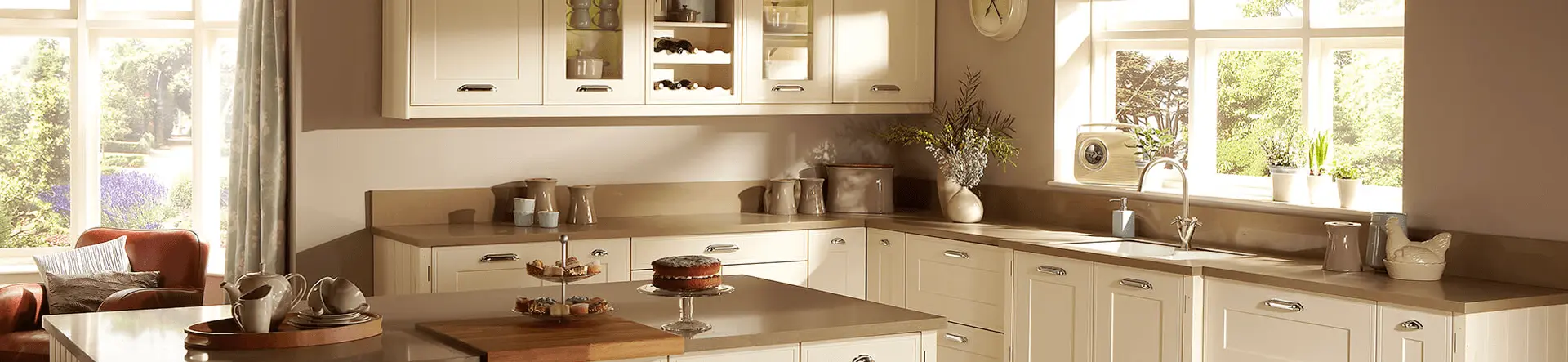
Kitchen. In kitchens where brass is the dominant metal—satin brass faucet, brass pendants, and crystal cabinet knobs with a Satin Brass base extend the scheme without adding another metal. In modern kitchens built around stainless appliances and chrome plumbing, crystal knobs with a Polished Nickel base offer a contrast pairing: nickel sits adjacent to stainless in temperature, while the crystal introduces texture the rest of the room lacks.
Bathroom. Most bathrooms have chrome plumbing as the fixed anchor. Crystal door knobs and crystal cabinet pulls in a Chrome or Satin Brushed Chrome base align directly with the plumbing without needing additional accent metals. In larger bathrooms with brass mirror frames or lighting, an Antique Brass base on the crystal knobs can carry the warm-metal accent and prevent the room from reading as a cool monochrome.
Bedroom. The bedroom has no fixed plumbing finish to anchor to, which makes it the room with the most flexibility in specification. Crystal knobs here can lead the metal selection rather than follow it. A Polished Nickel or Satin Brass base is the most versatile starting point, supporting later decisions about lighting and accessories.
5. The Material Foundation: Why Crystal and Brass Quality Matters in Mixed Schemes
Mixing hardware finishes is fundamentally a visual exercise, but the visual depends on a material foundation that holds up over time. In a mixed-metal scheme, one piece that ages poorly visibly compromises the others—a thin or off-color "brass" finish placed next to a properly weighted brass piece looks more wrong than two intentionally unmatched but well-made finishes ever would.
FUIN's crystal door knobs are made from lead-free crystal, which is important for regulatory compliance in regions with lead-content rules and for optical clarity that does not degrade over decades of use. The base is forged brass rather than zinc alloy plated with a brass coating; forged brass holds its finish without the dimensional sagging or finish flaking that plated zinc develops at high-touch points such as door knobs.
The crystal-to-base connection uses a proprietary mechanical bonding method developed over decades of manufacturing. This is relevant to mixed-finish discussions because crystal knobs that loosen at the joint—a common failure mode in adhesive-only constructions—eventually rotate or detach, breaking the visual line, whether the surrounding scheme is monochrome or mixed.
Material quality is not a substitute for design coordination. It is a precondition for it. A well-coordinated mixed-finish scheme on degrading hardware looks worse after five years of daily use than an over-matched scheme on durable hardware.
6. Common Pitfalls in Mixing Crystal with Other Finishes
A few patterns recur in mixed-metal rooms where crystal hardware falls short.
The first is using the crystal too widely. Crystal knobs read as accents. When every door and every cabinet across a floor uses crystal hardware, the room loses the contrast that makes crystal effective in the first place. A practical guideline is to limit crystal to one or two zones per floor—for example, entry doors plus bathroom cabinets—rather than committing every door surface to it.
The second is inconsistent base finishes across visually connected rooms. Crystal knobs with a Polished Brass base in one room and a Polished Chrome base in an adjacent room create a temperature jump if the two rooms are open to each other. The crystal element can move between rooms; the base finish should consistently follow the dominant metal of each room.
The third is combining too many crystal cuts. Faceted, smooth, and ribbed crystals each catch light differently. Using all three across a single floor creates visual noise, even when the base finishes coordinate cleanly. Selecting a single crystal style and letting the base finishes provide the variation produces a more coherent result.
The fourth is placing a crystal in low-light, high-traffic utility spaces. Crystal hardware works visually because it refracts light. In a windowless laundry room or a deep interior corridor, the optical payoff diminishes, and the maintenance burden remains. Crystal selections are better directed toward rooms with natural light.
7. A Decision Framework Before Specifying Crystal Knobs
For homeowners and designers weighing crystal hardware in a mixed-metal scheme, the questions below produce a clean specification when each can be answered with confidence:
What is the dominant metal in this room, identified by the largest committed hardware—plumbing, lighting, or appliances? Should the crystal knob align with this dominant metal, or contrast with a secondary? Which of the eight available base finishes corresponds to that decision? Is the crystal use limited to one or two zones per floor, rather than every door? And is the room well-lit enough for crystal to refract effectively?
When all five answers are settled, the crystal hardware specification will sit cleanly within the broader mixed-metal scheme. When any of them is uncertain, that uncertainty should be resolved before the crystal hardware is ordered—because the cost of redoing a hardware specification mid-project is higher than the cost of working through these questions in advance.
FUIN Design Hardware manufactures crystal door knobs, crystal door handles, crystal cabinet knobs, and crystal cabinet pulls in eight base finishes, built on lead-free crystal and forged brass foundations. For project specification, finish swatches, or sample requests, contact us or browse the full crystal door knob collection.
Related reading on the FUIN blog:
- How to Choose a Crystal Glass Door Knob for Interior Doors
- How to Enhance Interior Design with a Crystal Door Knob and Lever
- Benefits of Using Crystal Cabinet Pulls and Knobs in Kitchen Design
About the Author
Tyrone Huang is General Manager at FUIN Design Hardware, where he leads content strategy for the company's crystal door knob and brass hardware lines. He works closely with the manufacturing team to translate decades of expertise in forged brass and lead-free crystal into specification guidance for homeowners, designers, and architects. Connect on LinkedIn .